
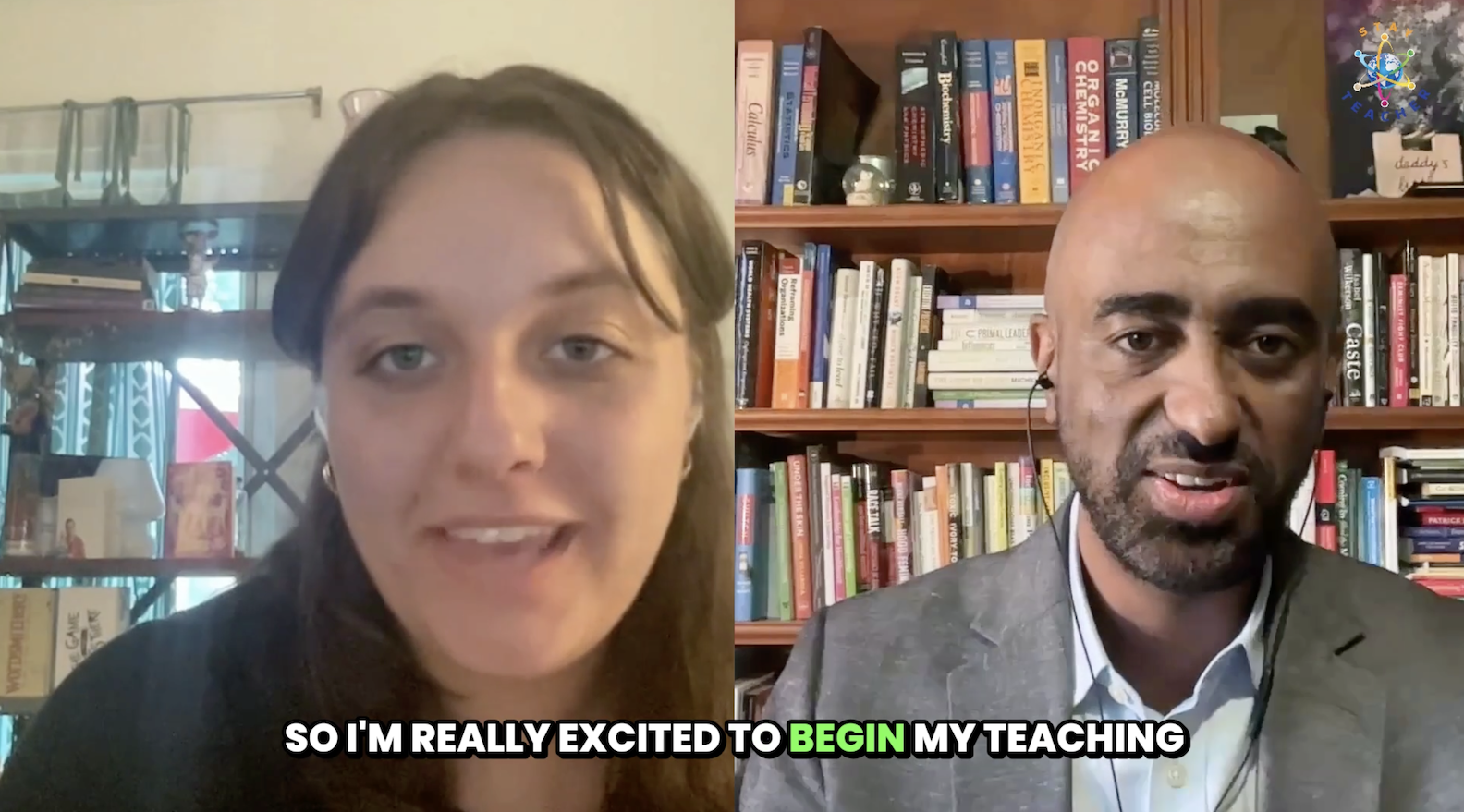
In the world of education, first-year teachers face a unique set of challenges, especially in special education. At age six Elise Thompson asked her parents for a whiteboard and markers.
Not toys. Not games. A whiteboard.
She hung it in her bedroom and spent hours teaching her stuffed animals — explaining lessons, writing on the board, doing what every great teacher does naturally before they even know what teaching is.
That little girl just graduated from her teaching program. The ink on her degree is barely dry. And she just accepted her first job offer as a special education teacher in Western Pennsylvania.
This is her story.
Some people discover teaching. Elise always knew.
She loved school. She loved learning. And she noticed early that not every student felt the same way — including her own brother who dreaded every day of it.
That bothered her.
"I just felt like it doesn't have to be that way."
So she became the student who quietly helped the kid next to her who didn't understand. The one teachers kept placing next to struggling students without her realizing why. The one who was, without knowing it, already teaching.
She also comes from a long line of educators. Her grandmother taught for 50 years. When Elise called her after a hard day with a student, something unexpected happened.
"When she spoke so eloquently about teaching I felt like I connected with her on a whole other level."
Roots run deep in Elise's family. And they run deep in her calling.
When Elise entered her teaching program she imagined herself in a second or fourth grade general education classroom — the kind she had always known as a student.
Then she did her student teaching placement in special education.
Everything changed.
"Here's where I finally get to talk to those students that I see in the Gen Ed classroom that I'm like — I wish I just had so much more time with you."
Special education gave her what general education could not — focused, intentional, individualized time with the students who needed it most. No juggling. No one getting pushed to the side. Just — I see you, and I am here specifically for you.
She described reading a student's IEP for the first time and feeling something click.
"I know exactly what this student needs from me."
That feeling — that clarity — is what sealed it.
Elise is entering one of the most critically understaffed roles in all of American education.
The special education teacher shortage is not new — but it is getting worse. Schools across the country are struggling to fill these positions, leaving students with disabilities without the specialized support their IEPs legally require. Substitute teachers are covering special education classrooms for months at a time. Caseloads are growing. Teachers are burning out faster.
The reasons are well documented — higher demands, more paperwork, larger caseloads, insufficient resources, and a systemic failure to support special education teachers the way their role requires.
And yet here is Elise — choosing this room on purpose.
Not because it is easy. Because it matters.
Every conversation on the Stay Teacher Podcast follows the ROOTS Framework — the five pillars that keep great teachers grounded through every storm of the profession.
Here is how Elise walked through hers:
R — Reason
A whiteboard in a six-year-old's bedroom. A grandmother who taught for 50 years. A moment in a special education classroom when she realized — this is where I am supposed to be.
O — Obstacles
Classroom management — the gap between what teaching looks like in theory and what it feels like in practice. The first time she stood in front of a class and felt like she was losing the room. The days she drove home wondering if she was cut out for this.
"If you don't have management in your classroom — you're not teaching."
O — Overcome
By leaning on her mentor teacher. By being vulnerable enough to walk into another teacher's classroom with tears in her eyes. By building a life outside school — the gym, walks with her dog, calling her mom, changing clothes the moment she got home to mentally separate work from life.
And by holding onto this truth a veteran teacher gave her early on:
"There are never two terrible days in a row."
T — Transformation
From a straight-A student who had no idea what went on behind the scenes of special education — the IEPs, the therapy services, the OT, PT, and speech teams working before and after school — to an educator who now sees the full picture of what it takes to serve every child.
"I hope I am becoming someone who can be aware and be insightful about where every student is coming from."
S — Stay
What will keep Elise in this profession? A strong mentorship program. Administrators who ask — "What do you need?"— instead of waiting for teachers to come to them. Resources provided rather than hunted for. And a school community where educators genuinely support each other.
"I don't think it should always fall on the teachers to advocate for what they need. That's the role of the administrator to ask."
Coach G asked Elise a direct question — why are teachers leaving the profession?
Her answer was clear and unflinching.
The demands are too high. Teachers are given curricula they know do not work but are forced to use anyway. Classrooms have not changed since the 1950s while everything else in the world has. And the difference between an administrator who genuinely supports their teachers and one who just pops in to monitor them is something every teacher feels immediately.
"Are you popping in because you can feel like you're monitoring me? Or are you coming in saying — hey, do you need a bathroom break, I can take over for a second?"
That difference — between surveillance and genuine support — is often the difference between a teacher who stays and one who walks away.
She also said something that should be posted in every superintendent's office in America:
"There are so many teachers in schools that are like — I know exactly how to fix this problem. But no one would ever ask me."
Coach G has been in education for over twenty years. He is a former special education teacher himself — and hearing Elise describe her experience brought him right back to his own first years in the classroom.
But Elise taught him something too.
On mentorship: Elise's emphasis on sustainable intentional mentorship programs — not just assigned and forgotten — reinforced what Coach G already knows and now advocates for in his district consulting work. Schools with strong mentorship programs keep teachers. Schools without them lose them.
On passion as an anchor: Elise described her hope to keep her passion as an anchor through the hard years of teaching. That phrase landed. Passion is not just a feeling — it is a strategy. It is the thing that pulls you back to your why when everything else feels like too much.
On asking instead of waiting: The most powerful thing administrators can do for new teachers is not wait for them to ask for help. They should ask first. Proactively. Consistently. Because first year teachers do not always know what they need — but they know when someone cares enough to ask.
"What do you need? What are two things we could do for you that would make your school year better?"
Those two questions alone could change the trajectory of a teacher's career.
Five years from now Elise sees a classroom that practically runs itself.
Students at differentiated stations. Hands-on learning. A buzz of engaged voices — not silence, not chaos, but the beautiful productive hum of students who know what they are supposed to be doing and are doing it.
A classroom where if you walked up to any student and asked — what are you working on? — they could tell you exactly.
And at the center of it all — a life skills program helping students become as independent as possible. Not just academically. In life.
"My goal continues to be getting kids to be able to be as independent as possible."
That is the vision. And knowing Elise — it will not just be a hope. It will be a reality.
The special education teacher shortage will not be solved by recruitment campaigns or signing bonuses alone.
It will be solved by people like Elise Thompson — who at age six already knew she was born to teach, who chose the hardest room in the building because those students deserved someone who would, and who is walking into her first classroom carrying twenty years of family legacy, a grandmother's wisdom, and a passion she describes as her anchor.
The students of Western Pennsylvania do not know it yet.
But they are getting exactly the teacher they deserve.
Hear Elise's full story — including her powerful moment of choosing special education, her honest advice for new teachers, and what she believes administrators must do to keep great teachers in the profession — on the Stay Teacher Podcast.
If this story moved you share it with one teacher today. And if you have a story to tell reach out at stayteacher.com — we want to hear it.
Your roots run deep.
Stay teacher.