
She had straight A's all her life.
She graduated valedictorian from her high school. She got into the University of Pittsburgh. She declared chemical engineering as her major.
And then one day sitting in a General Chemistry recitation before a nearly four hour lab someone in the room asked a question out loud that changed everything.
"Is anybody actually happy in this major?"
Everyone laughed. Someone said you do not get into engineering for the happiness — you get into it for the money.
Cashmere Starks went home and made a decision.
She was going to find her happiness. And she found it in a classroom.
Cashmere did not stumble into teaching. She chose it deliberately — after choosing against everything that did not feel right.
After leaving engineering she transferred into psychology and eventually discovered the CASE program at Pitt — a dual certification in special education and general education. She completed a four-plus-one program earning both her bachelor's in applied developmental psychology and her master's in early childhood education.
She also stayed home.
Her father was sick. Her city needed her. And Pittsburgh — the city that raised her — became both her classroom and her community.
"Staying at Pitt and staying in my home city was probably one of the best higher education choices I could have made for myself. I was able to immerse myself so much more into a city that I have already loved my whole life."
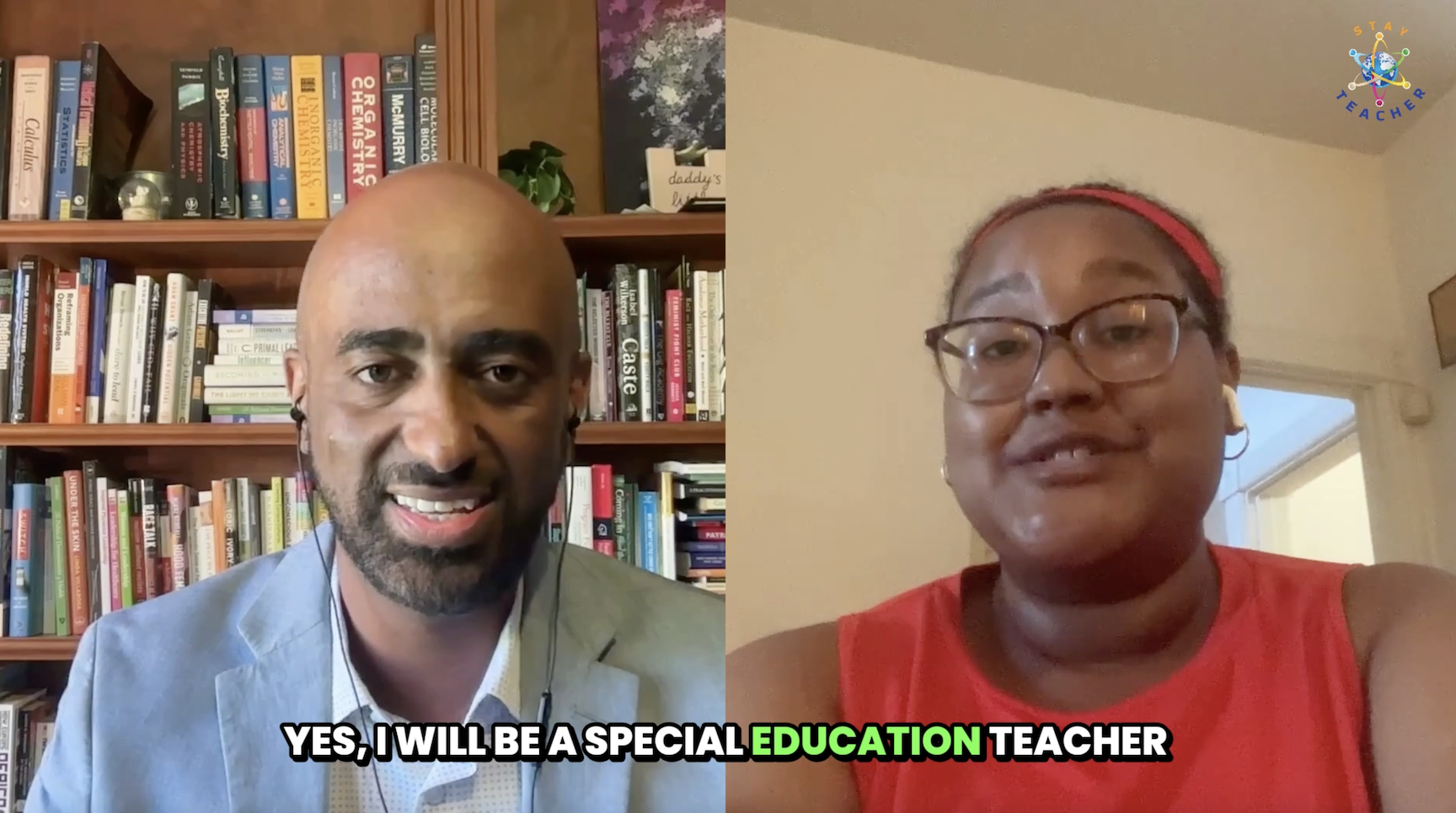
Now she is giving that love back — as a first year special education teacher at a charter school in the city she has never left.
When Coach G asked Cashmere about the teacher who most shaped her decision to enter this profession, she did not hesitate.
Michelle King.
A Black woman. A middle school teacher. And one of the only educators in Cashmere's predominantly white school — 79% white — who took the time to see her fully.
Michelle did not just teach. She created spaces specifically for the Black girls in her school. She built community among them. She told them — "Even if you aren't all friends with each other, you have to have each other's backs."
For Cashmere, who had rarely connected with other Black girls outside her family in that school environment, those spaces were transformative.
"That was one of the first times I was able to connect with multiple people culturally outside of my family."
That is what great teaching does. It echoes.
Cashmere is rare.
Not because of her talent — though she has it. Not because of her preparation — though it is exceptional. She is rare because only about 5% of teachers in the United States are Black women. And that number is not growing fast enough.
Coach G asked Cashmere directly — why?
Her answer was layered, honest, and historically grounded.
First — the school experience itself fails Black girls.
Cashmere spoke about adultrification — the documented phenomenon where Black girls are perceived as older, less innocent, and less in need of nurturing than their white peers. The result is that many Black girls move through their entire school experience without a single meaningful relationship with a teacher.
"A lot of them just do not feel anything when it comes to the adults in front of them. There's no relationship at all."
If you never had a teacher who truly saw you — why would you ever want to become one?
Second — the invisible tax on Black women in the workforce.
Black women are consistently told they must be twice as good to receive half the credit. In a profession that is already underpaid and undervalued that calculation becomes impossible to justify.
"As a Black woman we are always told we have to be twice as good to get half the credit. In a field like education where the job is already thankless — it is hard to justify going into a field where you know you are going to be overlooked and undervalued. And on top of that you're a woman. And on top of that you're Black."
Third — the pipeline is broken at the program level.
In Cashmere's own cohort at the University of Pittsburgh there were three Black women studying education. One dropped out before graduation. Two made it to the finish line.
Two.
That is not a coincidence. That is a symptom.
Every episode of the Stay Teacher Podcast follows the ROOTS Framework — five pillars that keep great teachers grounded through every storm of the profession.
Here is how Cashmere walked through hers:
R — Reason
Three reasons — her own school experience of going unseen until Michelle King found her, the happiness she discovered when she finally stopped chasing the wrong major, and the calling she felt when she entered the CASE program and realized she had found her life's purpose.
O — Obstacles
Switching majors. The stigma from family and community about teaching being a poor financial choice. The flood of negative teacher content on social media painting the profession as hopeless. And the weight of entering a field where barely 5% of educators look like her.
O — Overcome
By anchoring herself in the clarity of her calling. By remembering that only she is living her life. By leaning on her best friend and by holding onto the wisdom of a former boss who told her —
"This field takes heart work."
T — Transformation
From an 18-year-old who arrived at Pitt undecided and chasing a major that made her miserable — to a graduate who knows exactly who she is and exactly where she is going. Cashmere plans to start her career as a teacher and retire as a teacher.
"My intention is to start my life as a teacher and retire as a teacher."
S — Stay
Trust and support — calibrated to experience level. First year teachers need more support. Veteran teachers need more trust. And every teacher needs an administrator who is present, available, and willing to step in when things get hard — not just watch from the doorway.
One of the most powerful insights Cashmere shared was something every school leader should write down.
Administration tends to apply a one-size-fits-all approach to teacher support. Same expectations. Same level of oversight. Same level of trust — regardless of whether a teacher is in year one or year fifteen.
Cashmere pushed back on that directly.
"A first year teacher needs more support than trust. A teacher who has been in the classroom for fifteen or seventeen years needs more trust than support at that point."
Coach G has spent over twenty years in education — as a teacher, administrator, professor, and coach. And Cashmere still taught him something.
The trust vs. support balance by experience level is one of the clearest and most practical frameworks for administrator-teacher relationships that has been shared on this podcast. It is something Coach G is already incorporating into his district consulting conversations.
Heart work is not a metaphor — it is a strategy. Cashmere's former boss said it best. This field requires you to put your heart into it. And that means passion is not optional. It is the engine. Without it the demands of teaching will eventually outpace the reasons to stay.
The pipeline problem starts in the classroom. If Black girls spend their entire school career without a teacher who truly sees them — without a Michelle King — they will never see themselves as teachers. The recruitment problem is actually a relationship problem. And it starts years before anyone ever fills out a college application.
Ask Cashmere what her classroom will look like in five years and she does not hesitate.
Solid routines. Clear expectations. Students who always know exactly what they are supposed to be doing. And pockets of joy built intentionally into every week — time for students to laugh, build relationships, and just be kids before the pressure of exams returns.
Her students will tell you she is fun. They will tell you she jokes with them. They will tell you she is a self-described nerd — with superheroes and anime woven into the fabric of her classroom because joy and learning are not opposites.
And they will tell you she holds both things at once — this is a learning environment and it can also be a place you love being in.
"I give that balance of — this is a learning environment, so we are gonna work and we're gonna learn, and that's not negotiable. But we can also have fun."
If you are a Black woman in high school or college wondering whether teaching is the right path — Cashmere has three words for you.
Passion. Patience. Perspective.
"You have to think about the fact that children aren't just bodies that are gonna fill your chairs. They are people. So you have to be prepared to deal with a lot of people. But it's an impactful career. It's a career that makes a big change in at the very least one person's life."
And if that sounds like something you are willing to put your heart into —
"One thing about teaching is that it will always be rewarding."
Cashmere Starks could have been an engineer.
She would have been successful. She would have made good money. She would have been fine.
But she would not have been happy. And somewhere in that chemistry recitation she made the decision that happiness — real happiness rooted in purpose and service — was worth more than a salary.
She chose a field where only 5% of educators look like her. She chose special education — one of the most demanding and underserved roles in all of American education. She chose Pittsburgh — the city that raised her — as the place where she will pour out everything she has been given.
Her students do not know it yet.
But they are about to meet exactly the teacher they have been waiting for.
Hear Cashmere's full story — including why she left engineering for education, her powerful tribute to her first amazing teacher Michelle King, and what she believes schools must do to recruit and keep Black women in the profession — on the Stay Teacher Podcast.
If this story moved you share it with one teacher today. And if you have a story to tell reach out at stayteacher.com — we want to hear it.
Your roots run deep.
Stay teacher.
— Coach G