
There is a number that every educator, administrator, and school board member in America needs to sit with.
Less than 3%.
That is the percentage of public school teachers in the United States who are Black males.
Not 10%. Not 5%. Less than 3%.
In a country where millions of Black and brown students sit in classrooms every single day — many of them never seeing a teacher who looks like them — that number is not just a statistic. It is a crisis.
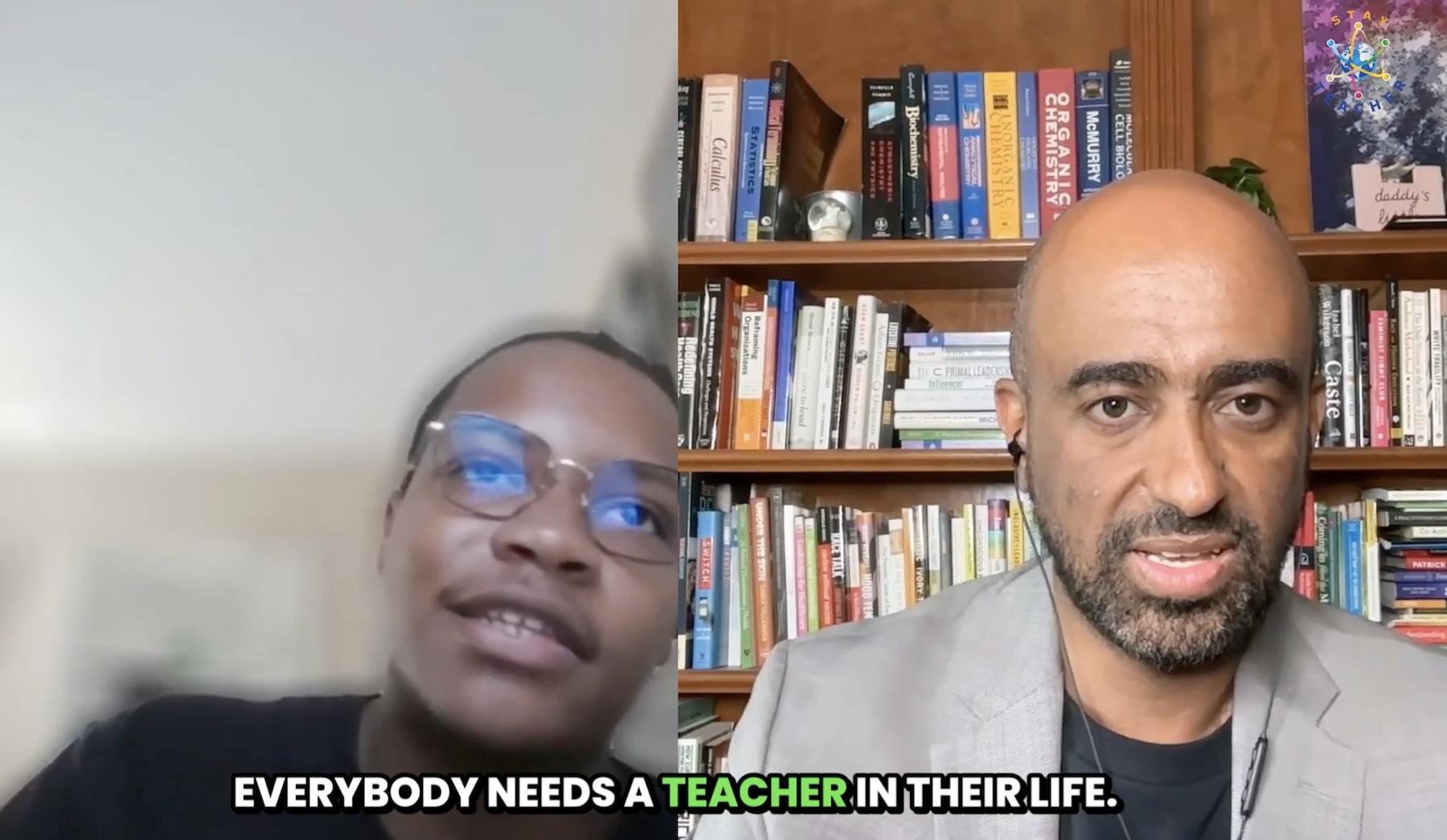
In Episode 3 of the Stay Teacher Podcast, Coach G sat down with Isaac Sanders — a University of Pittsburgh senior from Detroit, Michigan, who is choosing to do something about it.
Isaac did not stumble into education. He was raised inside it.
His mother has been an educator for over 25 years. Before Isaac could fully understand what a classroom was, he was already in one — helping his mother move chairs, hang posters, and build an environment for students before the school year began.
That experience planted something in him. A sense that classrooms are not just buildings. They are communities. And communities need to be built with care, intention, and love.
But the moment that turned that feeling into a decision came the summer before his freshman year of college — when Isaac joined the Freedom Schools Literacy Academy. A program focused on helping first through third grade Black and brown students learn to read through joy, chants, energy, and community.
Isaac was a Junior Servant Leader.
This summer he returned as a Servant Leader Apprentice — and described it as a full circle moment.
"This program is truly what made me want to become a teacher. Doing it this summer was a full circle moment. I'm just happy to be back."
Coach G asked Isaac a question that education leaders have been struggling with for decades.
Why aren't more Black male educators entering the teaching field?
Isaac did not hesitate.
His answer was rooted in history, in research, and in lived experience — and every educator in America needs to hear it.
First — the school system has historically pushed Black males out, not in.
When a young Black male gets in trouble at school, the first response is too often suspension. Not conversation. Not support. Removal. Isaac connected this directly to why Black men do not return to the institution that policed them.
"Why would we want to go back into the school — to the same system that caused us all this trouble?"
Second — research confirms what Black students feel every day.
Isaac referenced a study that tracked teachers' eyes in classrooms. The results showed that teachers consistently followed Black students more than others — a form of surveillance that Black children absorb and carry long after they leave school.
Third — history destroyed the Black teacher pipeline.
This is the part of the story that does not get told enough.
After Brown v. Board of Education — the landmark Supreme Court ruling that ended school segregation — over 5,000 Black teachers were fired. Entire schools that had been taught exclusively by Black educators were dismantled. The Black teacher pipeline that had been built over generations was severed in a single decade.
We are still living with those consequences today.
"We were forced to be pushed out. And I think that's also another factor as to why the percentage of Black teachers in the pipeline might be so low at this point."
What makes Isaac's story even more powerful is how personal his connection to struggling students really is.
Isaac grew up with an IEP. He struggled with stuttering. He was the student pulled out of class for extra services. He was the student with a 2.3 GPA in eighth grade.
And then — with support, belief, and the right environment — he became the student with a 3.8 GPA throughout high school.
He has lived on both sides of the school system. And he is walking into his classroom carrying both of those students inside him.
"I come to a classroom with care first. With understanding first. Rather than any preconceived notion of who somebody could be. Because who are we to ever judge anybody else? We're just as imperfect."
His transformation word is empathy — and it was earned, not assumed.
Every conversation on the Stay Teacher Podcast follows the ROOTS Framework — five pillars that keep great teachers grounded through every storm of the profession.
Here is how Isaac walked through his:
R — Reason
A mother who spent 25 years building classrooms. A summer program that lit a fire. And a deep personal conviction that Black students deserve to see someone who looks like them standing at the front of the room.
O — Obstacles
The noise — family members and friends questioning whether teaching was the right choice, citing low pay and difficult students. And the larger systemic obstacle — entering a profession that has historically excluded people who look like him.
O — Overcome
By surrounding himself with other future educators. By going to his mother. By choosing to uplift every other Black educator he meets — "We're gonna go do it together."
T — Transformation
From a student with an IEP and a 2.3 GPA to a future teacher who understands that every behavior is a form of communication — and that a student's mental and physical state determines whether they can learn that day.
S — Stay
Give Black educators space to bring their culture into the curriculum. Celebrate them publicly and consistently. Stop using strong Black teachers as tools to fix problems. Trust them. Honor them. Elevate them.
When Coach G asked Isaac what administrators need to do to keep Black male educators in the profession, his answer was clear, specific, and urgent.
Give them space to bring culture into the curriculum. The curriculum does not know Isaac's students. Isaac does. Let him teach accordingly.
Stop policing Black teachers. The same systemic policing that pushed Black males out of school as students shows up again in the workplace — and it drives them out of the profession.
Celebrate teachers when their students grow. Not just in words. In action. In public recognition. In honoring the work.
Do not use your strongest Black teachers as a tool.
Isaac shared a story about his mother — a veteran educator of 25 years — who was moved from her elementary classroom to middle school social studies in the middle of the school year. Not because it was good for her. Because she was effective and the school needed her somewhere else.
Her students still grew. But she was used — not celebrated.
"Making sure you're not using your Black teachers because you know they can demand a certain amount of respect from their students. You have to make sure that they know that you see them."
In five years Isaac sees himself in a third or fourth grade classroom. And when he describes it, you can almost see it.
Black heroes on the walls. Beanbags and flexible seating. A space where students can take their shoes off and feel at home. No permanently assigned seats — instead, letting students naturally gravitate toward who they trust and who they connect with.
A classroom where every behavior is recognized as communication.
A classroom where students come as they are.
A classroom that belongs to everyone in it.
"It's not just my classroom. It's our classroom."
If you are a Black student in high school or college wondering whether teaching is worth it — Isaac has something to say to you.
Show up. Because your presence alone is transformative.
"When it's less than 3% of Black male teachers, you bring a special energy to the classroom just by being who you are. Students respond differently. It's impactful for students to have a Black male teacher. Some students can go their entire lives without ever having one."
And to every teacher regardless of background — Isaac left the audience with this:
"Dig into the history of this country. Understand how it has disenfranchised communities and people of color. That's when you will really understand another perspective. It opens your heart. It opens your mind. And then always be a learner. You never stop learning from your students."
Less than 3% of teachers in America are Black males.
That number does not change by accident. It changes because young men like Isaac Sanders make a different choice. Because programs like Freedom Schools Literacy Academy plant a seed. Because mothers like Isaac's spend 25 years showing their children what devotion to this profession looks like.
And it changes because educators, administrators, and communities decide — together — that every child deserves to see themselves reflected in the person standing at the front of the room.
Isaac Sanders is 3%. And he is just getting started.
Hear Isaac's full story — including his powerful explanation of why Black male teachers are underrepresented, his mother's 25-year journey in education, and his vision for the classroom he is building — on the Stay Teacher Podcast.
If this story moved you share it with one educator today. And if you have a story to tell reach out at stayteacher.com — we want to hear it.
Your roots run deep.
Stay teacher.
— Coach G